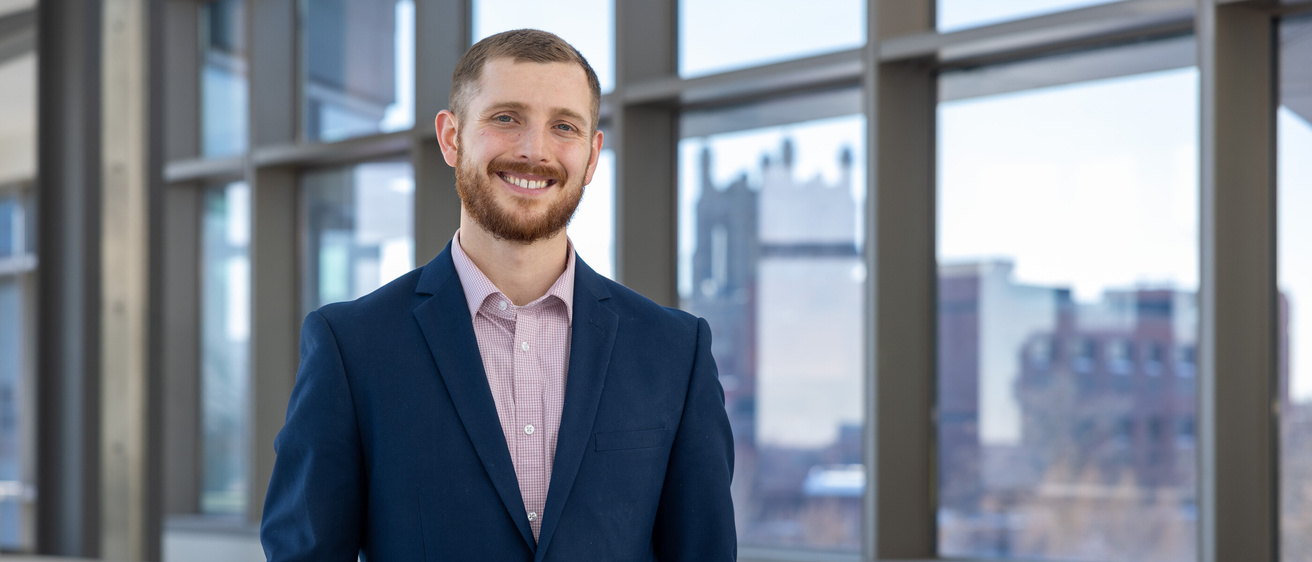
From Holstein in northwest Iowa to rural Storm Lake clinics, Jacob Kliegl’s path to physical therapy has been shaped by family, persistence, and purpose. An Iowa State University graduate who earned his Doctor of Physical Therapy at the University of Iowa Roy J. and Lucille A. Carver College of Medicine, Kliegl reflects on finding his passion for patient care, balancing graduate school with parenthood, and returning close to home to serve the community that shaped him.
What first drew you to physical therapy as a career?
I was first introduced to the field when I was a high school athlete and had injuries, so I spent some time in PT. I thought it was interesting, but I wasn’t completely sure at the time. When I started college, I was undecided and explored a few different paths — engineering, industrial technology — but nothing really clicked. I realized I was much more interested in the human body and healthcare.
What ultimately drew me to PT was the unique role PTs have in the medical system. We get 45 minutes to an hour with patients, sometimes seeing them several times a week. You get to know people, see the small steps of progress, and help them return to what matters most to them — whether that’s a high school athlete getting back to competition or an older adult safely navigating stairs and staying independent. That variety and connection really stood out to me.
Why did you choose CCOM for your physical therapy degree?
It’s hard to say no to a program that’s affordable, consistently ranked among the best, and filled with people who truly support you. It’s top-tier education without the burden of overwhelming debt. If you have the opportunity to come to Iowa, it’s a no-brainer — you take it.
What people and experiences at the CCOM shaped your time at Iowa?
The entire faculty genuinely cares about students. That includes professors and support staff — everyone you interact with wants to help you succeed and get to know you as a person, not just a student. Carol Leigh stands out. I’m married and have two kids, and every time I ran into her, she asked how my kids were doing. That meant a lot to me. It made me feel seen and supported, especially as a parent in the program.
A lot of my fondest memories are centered around my family. After a tough week, my wife, kids, and I would go out for ice cream — those moments really stand out. Even just coming home after a long day and seeing my kids excited to see me, going to the park together — that’s what I’ll remember most.
What was it like school and family life?
My oldest will be three soon, and our daughter is about a year and a half. My wife Elizabeth and I had our son right before I graduated from Iowa State, and our daughter was born in the summer between my first and second years of PT school. It was definitely hectic. Balancing school, family, and everything else was a challenge, but it actually helped me in a lot of ways.
I became very disciplined with my time. I didn’t want to be up late every night studying — I wanted to be home with my wife and kids. That forced me to use my time at school efficiently. In a way, it was like a “cheat code” for learning how to focus and manage time, which I think a lot of students struggle with.
Our PT program has an emphasis on getting students involved in research. What was your research project? Tell us about your research project.
I worked with Dr. Chimenti on a cross-cultural adaptation of outcome measures for Achilles tendinopathy, specifically translating and validating them for Spanish-speaking populations. We sent the translated measures to clinics in Spain and Latin America to see if they produced results comparable to the English versions. It was interesting work and rewarding to know it could help make care more accessible for non-English speakers.
What advice would you give to incoming PT students?
First, learn how you actually study and learn. PT school demands more than undergrad, and figuring that out early can make a big difference. Time management is huge — using your time well during the day can save you a lot of stress at night and on weekends. And finally, make sure you have a strong support system. Whether it’s family or close friends, you need people who can help you through the tough days and remind you why you’re doing this.
And if you have a family, they still need to be a priority. School is demanding, but you can’t let your spouse or kids take a back seat entirely. It’s about balance — doing what you need to do for school while still being present for your family.
What’s next for you?
I’ll be working at Buena Vista Regional Medical Center in Storm Lake, Iowa. I’m excited to return to northwest Iowa, be close to both sides of both my wife and my family and serve a community that really depends on its healthcare providers. Rural practice offers so much variety — you might see an older adult working on balance, a post-op knee replacement, and a high school athlete all in the same day. That keeps you engaged and always learning.